CNC Milling
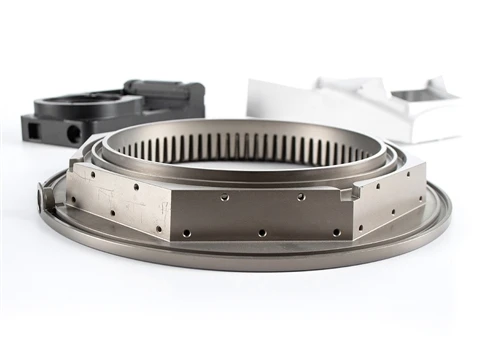
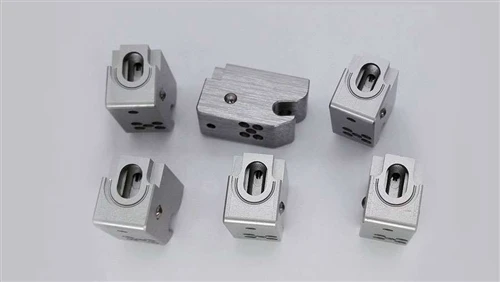
CNC milling uses rotating cutting tools to remove material from a workpiece. It can produce flat surfaces, slots, pockets, holes, steps, and complex 3D contours.
3-axis milling is suitable for many standard components, while 5-axis CNC machining allows the cutting tool to approach a part from multiple directions. This is particularly useful for complex geometries, curved surfaces, and components that require fewer setups.
Common materials for CNC milling include aluminum, stainless steel, titanium, brass, and engineering plastics.
CNC Turning
CNC turning is mainly used for rotational components. During the process, the workpiece rotates while a cutting tool removes material from its outer or inner surfaces.
Turning can produce:
Shafts
Bushings
Pins
Threaded components
Cylindrical housings
Flanges
Precision fittings
For parts combining milling and turning features, mill-turn machining can reduce the number of setups and improve production efficiency.
CNC Drilling
CNC drilling creates holes with controlled diameter, position, and depth. Drilling operations are commonly combined with milling or turning during the machining process.
Depending on the drawing requirements, CNC machining can include through holes, blind holes, counterbores, countersinks, and threaded holes.
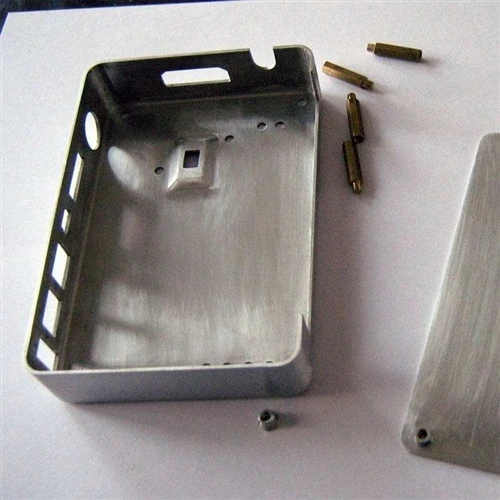
Accurate hole positioning is particularly important for components that need to be assembled with other mechanical parts, such as robot joints, automation equipment, electronic housings, and precision fixtures.
CNC Grinding
Grinding uses an abrasive wheel to remove a small amount of material and achieve a high level of dimensional accuracy and surface quality.
It is often used as a secondary machining process when tighter tolerances or smoother surfaces are required. Grinding can be applied to precision shafts, molds, tooling, mechanical components, and other parts with demanding dimensional requirements.
How to Choose the Right CNC Process?
The machining process should be selected based on the part's geometry and technical requirements rather than simply the material.
Important factors include:
Part geometry and complexity
Required dimensional tolerances
Surface finish requirements
Material type and hardness
Production quantity
Number of setups
Required lead time
Post-machining surface treatment
For example, a simple block with pockets may be efficiently produced by 3-axis milling, while a complex component with multiple angled surfaces may benefit from 5-axis machining.
CNC Machining for Custom Parts
At Jingcheng, CNC machining processes can be selected according to the customer's drawings, 3D models, material specifications, tolerances, and application requirements.
Our machining capabilities include 3-axis and 5-axis CNC machining for prototypes and low-volume production. We work with materials including aluminum, stainless steel, titanium, and engineering plastics for customized precision components.
Send us your 2D drawing or 3D CAD file to discuss the machining process, material, tolerance, and production requirements for your project.