How Wire Cutting Helps Machine Complex Precision Parts
In precision manufacturing, some metal parts are difficult to complete with conventional milling or drilling alone. Narrow slots, small internal profiles, sharp corners and complex contours can require additional machining methods. Wire cutting is one of the processes we use when a component needs controlled cutting along a defined profile.
Unlike conventional cutting, wire cutting uses a continuously moving wire electrode to remove material through electrical discharge. Because the cutting tool does not directly apply mechanical cutting force to the workpiece, the process is suitable for producing fine contours and detailed features on conductive metal materials.
One of the main advantages of wire cutting is its ability to handle complex profiles. For parts with narrow openings, intricate shapes or internal contours, the wire can follow the programmed path according to the CAD drawing. This makes it useful for precision brackets, tooling components, mechanical inserts, special fixtures and customized industrial parts.
Material hardness is another consideration. Some metal components become difficult to machine efficiently after heat treatment. Wire cutting can process conductive hardened materials without relying on a conventional milling cutter to remove the material mechanically. This can reduce the need for complicated tool selection when producing certain precision features.
Wire cutting is also useful for prototypes and low-volume production. When only a limited number of parts are required, customers may not want to invest in dedicated tooling. A programmed cutting path can be used to produce the required profile directly from the engineering drawing or CAD model.
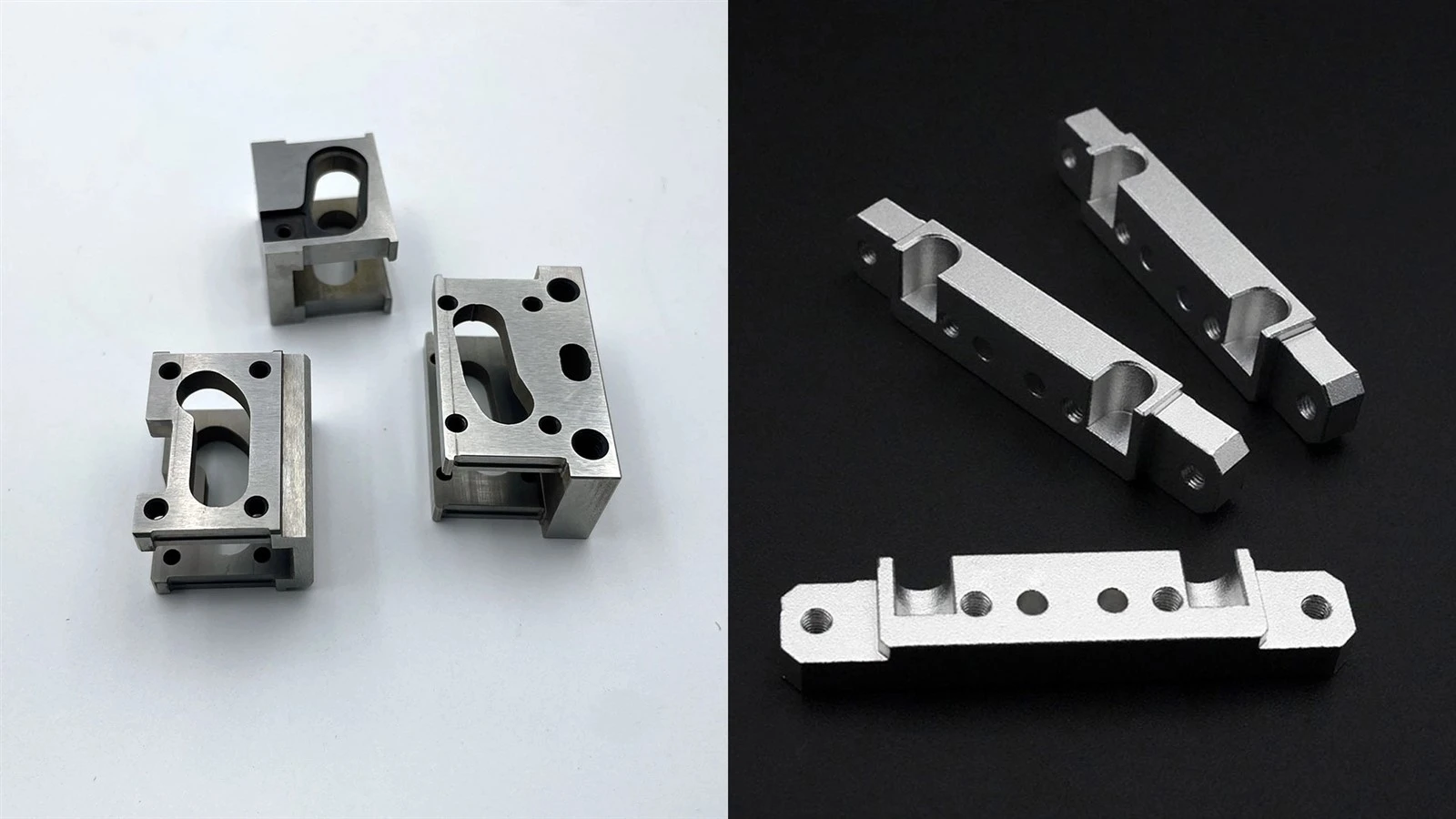
Wire-cut electrical discharge machining (left) and conventional milling (right) - each has its own advantages depending on the application.
At Jingcheng Dingyi, wire cutting can be combined with CNC milling, drilling, grinding and other machining operations according to the part structure. For example, a component may first be CNC machined to create its main geometry, followed by wire cutting for a narrow slot or complex profile that requires a different machining approach.
Before production, our team reviews the drawings and checks critical dimensions, material requirements and machining relationships. After processing, key features are inspected to confirm dimensional accuracy and consistency.
For custom precision parts with complex contours, small openings or special internal profiles, choosing the right machining process can make production more practical and stable. Jingcheng Dingyi supports custom machining for prototypes, one-off components and low-volume orders. Send us your 2D drawing or 3D CAD file for a manufacturing review and quotation.