Choosing the Right Aluminum Alloy
Different aluminum alloys provide different levels of strength, machinability, and corrosion resistance.
6061 aluminum is commonly selected for general structural components, housings, brackets, and equipment parts because it offers a good balance of strength and machinability.
7075 aluminum provides higher strength and is suitable for applications where weight reduction and mechanical performance are important, such as robot components, aerospace parts, and high-performance mechanical assemblies.
The material should be selected according to the part's actual working conditions rather than simply choosing the strongest alloy.

CNC Machining for Complex Aluminum Parts
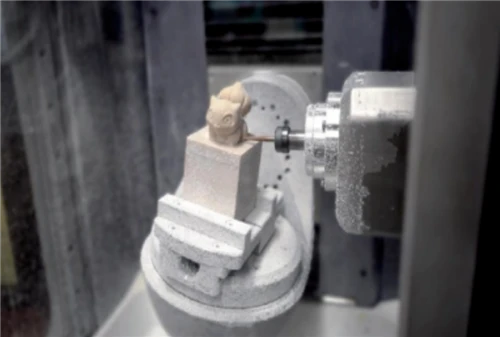
CNC milling and turning allow us to produce aluminum components with complex geometries and precise dimensions. For parts with multiple angled surfaces, deep pockets, or complex contours, 5-axis CNC machining can reduce repeated setups and improve machining efficiency.
During production, we pay attention to cutting parameters, tool selection, workholding, and machining sequence. These factors are particularly important for thin-wall structures and parts with tight tolerances, where excessive cutting forces can cause deformation.
For prototypes and low-volume production, we can also review the customer's design before machining and identify potential manufacturing issues based on the drawings and 3D files.
Surface Finishing for Aluminum Parts
After CNC machining, aluminum parts can be further processed according to the application and appearance requirements.
Common options include anodizing, clear anodizing, bead blasting, brushing, and other surface treatments. Anodizing can improve surface protection while providing different appearance options.
The appropriate finish depends on factors such as corrosion resistance, wear resistance, electrical requirements, dimensional requirements, and the final appearance of the component.
Applications of Precision Aluminum Parts
Our custom aluminum CNC machining services can be used for a wide range of components, including:
- Robot joints, brackets, and structural components
- Automation equipment parts
- Medical device components
- Aerospace aluminum components
- Electronic equipment housings
- Heat dissipation components
- Industrial machine parts
- Custom prototypes and low-volume parts
From Drawings to Finished Parts
Efficient aluminum part manufacturing is not simply about machining faster. A suitable material, practical machining strategy, controlled production process, and reliable inspection method all contribute to consistent results.
At Jingcheng, we work from customer 2D drawings and 3D STEP files to evaluate the part structure, material, tolerances, quantity, and finishing requirements before production.
If you have a custom aluminum component to manufacture, send us your drawings or 3D files. Our team can review the project and discuss a suitable CNC machining solution for your application.