


What Is a Fillet?
A fillet is a rounded transition between two surfaces. Instead of creating a sharp corner, the edge is machined with a specific radius, such as R2 or R5.
Fillets are often used to:
- Reduce stress concentration
- Improve part strength
- Make components safer to handle
- Improve the flow of material or fluids
- Create smoother transitions between surfaces
For parts exposed to repeated loads or vibration, a suitable fillet can help avoid sharp internal corners that may concentrate stress.

What Is a Chamfer?
A chamfer is a straight, angled surface that removes a sharp edge. A common specification is 1 × 45°, meaning a 1 mm edge is removed at a 45° angle.
Chamfers are commonly used to:
- Remove sharp edges
- Make assembly easier
- Help screws and fasteners enter smoothly
- Reduce the risk of edge damage
- Improve the appearance of machined parts
Chamfers are generally simple to machine and are widely used on CNC-machined components.
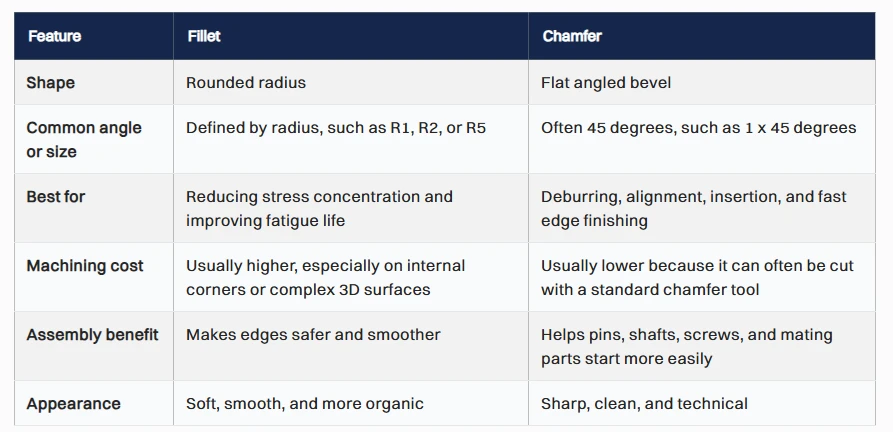
Fillet vs Chamfer
| Feature | Fillet | Chamfer |
|---|---|---|
| Shape | Rounded | Angled/flat |
| Specification | Radius (R) | Width + angle |
| Main purpose | Strength and smooth transition | Edge breaking and assembly |
| Internal corners | Common | More limited |
| Machining | May require suitable tooling | Usually straightforward |

When Should You Use Each?
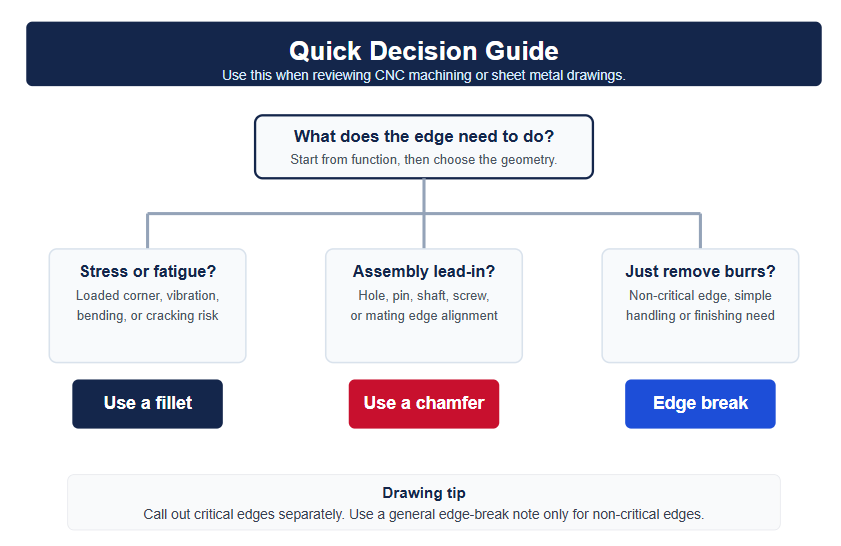
Choose a fillet when the corner needs a smooth radius, especially where stress, strength, or clearance is important.
Choose a chamfer when you mainly need to remove a sharp edge or make assembly easier.
For CNC machining, the choice should also consider tooling and accessibility. Very small internal fillets may require smaller cutting tools, while a chamfer can often be produced more easily.
At Jingcheng, we can machine both fillets and chamfers according to your 2D drawings or 3D models, including prototypes and low-volume CNC parts in aluminum, stainless steel, titanium, and engineering plastics.


