Why CNC Machining Is Essential for Humanoid Robot Parts
Humanoid robots pack dozens of actuators, sensors, and mechanical linkages into a human-sized frame. Every part has to be lightweight, strong, and dimensionally accurate enough to work in tight assemblies without binding, vibrating, or failing under repeated load cycles. Unlike consumer electronics housings, robot parts machining often requires tolerances measured in microns, particularly for joints and end effectors where even small deviations cause misalignment across a kinematic chain.
CNC machining meets these requirements because it offers:
Repeatable precision across production runs, critical when a robot has 20+ identical or near-identical joints
Design flexibility to machine complex geometries, internal channels for wiring, and lightweight lattice or pocketed structures
Material versatility, allowing engineers to switch between aluminum, titanium, and engineering plastics depending on load and weight requirements
Fast iteration, which matters enormously during the prototyping phase of humanoid robot development, when joint designs and arm geometries change frequently
For companies developing next-generation robots, precision CNC machining for robotics isn't a manufacturing afterthought - it's a design constraint that shapes how engineers approach the entire robot architecture from the earliest CAD stage. In practice, robot parts machining decisions made during prototyping often determine whether a joint design can even be scaled into mass production later on.

Core Humanoid Robot Components Manufactured via CNC
When engineers talk about CNC machining humanoid robot parts, they are usually referring to five categories of components that make up the bulk of a robot's mechanical system: joints, arms, end effectors, housings, and structural frames. Each category places different demands on robot parts machining, from micron-level tolerances at bearing surfaces to lightweight pocketing across large structural panels.

Robot Joints
Joints are arguably the most demanding application for CNC machined robot joints. A humanoid robot may have hip, knee, ankle, shoulder, elbow, wrist, and neck joints, each requiring precise mating surfaces for bearings, harmonic drives, or planetary gear sets. Machining tolerances at the joint level directly affect backlash, friction, and how accurately a robot can control torque and position.
Typical machined joint components include:
- Actuator housings that must align perfectly with motor shafts
- Bearing seats requiring tight roundness and concentricity tolerances
- Gear interface plates that transmit torque without slippage
- Cross-roller bearing races for compact, high-load joints
Because joints undergo constant cyclic loading, machined parts here are often finished with hard anodizing or nitriding to resist wear over millions of motion cycles.

Robot Arms
Robot arm CNC machining focuses on structural segments that need to be strong yet lightweight, since every gram added to an arm increases the torque demand on the shoulder joint. Upper arm and forearm segments are typically machined from aluminum or carbon-fiber-reinforced composites, using pocketing and rib structures to remove unnecessary mass while preserving stiffness.
Key considerations for arm components include:
- Consistent wall thickness to avoid warping during machining
- Integrated cable routing channels for internal wiring
Mounting bosses machined to tight positional tolerances so arms attach squarely to shoulder assemblies

End Effectors
End effector machining covers robotic hands, grippers, and fingertip assemblies - arguably the most intricate parts on a humanoid robot. Fingers may contain miniature linkages, tendon-routing channels, or embedded sensor mounts, all machined at a small scale where tolerance stack-up becomes a major engineering challenge.
Common end effector parts include:
- Finger phalanges with tendon or cable channels
- Palm structures housing actuators or gear trains
- Fingertip sensor housings for tactile feedback
Quick-change mounting interfaces for swapping grippers
Because end effectors interact directly with objects and environments, surface finish and edge quality are especially important to avoid snagging cables or damaging delicate items during manipulation.

Robot Housings
Robot housing manufacturing protects internal electronics, wiring harnesses, and sensors from impact, dust, and in some cases moisture. CNC machined housings are favored over molded plastic in early production runs and for high-load enclosures because they can achieve tighter fits and better structural integration with the surrounding chassis.
Typical housing components:
- Sensor enclosures for cameras, LiDAR, or IMUs
- Battery compartment housings with precise mounting features
- Electronics bay covers with machined seals for dust/water resistance
- Torso shell segments that combine protection with aesthetic design

Structural Frames
Structural frame machining forms the skeleton that every other component attaches to. Torso frames, spine structures, and chassis rails need to handle the combined load of actuators, batteries, and payload while keeping the overall robot mass as low as possible.
These frames are often machined with:
- Topology-optimized pocketing to reduce weight without sacrificing rigidity
- Precision-bored mounting holes for actuator and joint attachment
- Integrated cable pass-throughs to keep wiring internal and protected
- Modular interfaces allowing different subassemblies (arms, legs, head) to bolt onto a common frame
CNC Processes and Technologies Used
Manufacturing humanoid robot parts typically draws on several CNC processes working together:
5-axis CNC machining
which allows complex joint and housing geometries to be machined in a single setup, improving accuracy and reducing lead time


CNC milling
used for structural frames, housings, and flat or contoured surfaces
CNC turning
applied to cylindrical components like actuator shafts, bushings, and joint pins


Wire EDM
used for intricate internal features in gear components or hardened materials that are difficult to mill
Surface treatments
such as anodizing, black oxide coating, or PTFE coating to improve wear resistance and reduce friction in moving joints

Material Selection for Humanoid Robot Parts
Material choice has a direct impact on a robot's strength-to-weight ratio and battery life, since heavier robots consume more energy per movement. Common materials in CNC machined robot parts include:

Aluminum alloys (6061, 7075)
lightweight, machinable, and widely used for arms, frames, and housings

Titanium alloys
chosen for high-load joints and structural elements where strength-to-weight ratio is critical

Stainless steel
used in gears, pins, and wear-critical components requiring hardness and corrosion resistance

Engineering plastics (PEEK, Delrin, nylon)
used for low-load housings, bushings, and insulating components where weight savings outweigh strength requirements

Tolerances and Quality Control
Precision is only meaningful if it's verifiable. Reputable manufacturers experienced in CNC machining humanoid robot parts back up their tolerance claims with documented inspection data rather than spec sheets alone. Robot parts machining at this level of precision relies on:
Coordinate measuring machines (CMM) to verify critical dimensions and geometric tolerances
Surface roughness testing for bearing and sliding interfaces
Batch traceability, especially important for aerospace-grade titanium or safety-critical joint components
First article inspection (FAI) reports before full production runs begin
Tight tolerance machining for robot components typically falls in the range of ±0.005mm to ±0.02mm for critical joint and bearing surfaces, with looser tolerances applied to non-critical housing or cosmetic parts to control cost.
Choosing a CNC Machining Partner for Robot Manufacturing
Not every machine shop is equipped to handle the combination of tight tolerances, exotic materials, and rapid design iteration that humanoid robotics demands. Choosing the right partner for CNC machining humanoid robot parts can make the difference between a joint design that survives durability testing and one that fails after a few thousand cycles. When evaluating a partner for custom robot parts manufacturing, engineering teams typically look for:
Experience specifically with robotics or aerospace-grade tolerances, not just general machining
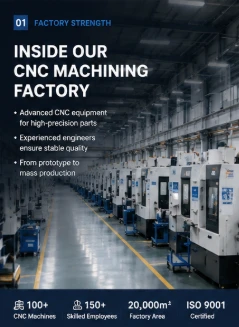
In-house 5-axis capability to reduce part handling and improve repeatability
Fast prototyping turnaround to support iterative joint and arm redesigns
Material expertise across aluminum, titanium, and engineering plastics
Documented quality control processes with CMM inspection reports
Manufacturers with a track record across both prototyping and scaled production tend to serve humanoid robotics programs best, since these projects often move quickly from a handful of prototype units to hundreds of production parts.
Future Trends in Robot Parts Machining
As humanoid robot programs scale, several trends are shaping the future of precision manufacturing in this space:
- Hybrid manufacturing, combining CNC machining with additive manufacturing for topology-optimized structural frames
- Increased use of titanium and composite materials as companies push for lighter, stronger joints and limbs
- Automated CNC inspection integration, feeding CMM data directly into digital twins for faster design validation
- Modular part families, where joint and housing designs are standardized across multiple robot platforms to reduce machining costs at scale

Conclusion
CNC machining humanoid robot parts sits at the intersection of mechanical engineering, materials science, and manufacturing precision. From robot joints that must rotate smoothly across millions of cycles, to end effectors capable of delicate manipulation, to the structural frames holding everything together, precision machining directly determines how capable, durable, and efficient a humanoid robot can be. As the humanoid robotics industry matures, robot parts machining will remain a foundational discipline - one where manufacturing quality is inseparable from robotic performance. Companies that treat CNC machining humanoid robot parts as a core engineering discipline, rather than an outsourced afterthought, are the ones most likely to ship robots that perform reliably outside the lab.
FAQ
Q: What tolerances are typical for CNC machined humanoid robot joints?
A: Critical joint and bearing surfaces are often machined to tolerances between ±0.005mm and ±0.02mm, depending on the load and precision requirements of the specific joint.
Q: Which materials are most commonly used for humanoid robot arms?
A: Aluminum alloys such as 6061 and 7075 are most common due to their favorable strength-to-weight ratio, with titanium used in higher-load structural applications.
Q: Why is 5-axis CNC machining preferred for robot components?
A: 5-axis machining allows complex geometries - such as joint housings and structural frames - to be machined in a single setup, improving dimensional accuracy and reducing production time compared to multi-setup 3-axis processes.
Q: Can CNC machining be used for both prototyping and mass production of robot parts?
A: Yes. CNC machining is well suited to both low-volume prototyping, where design iteration is frequent, and scaled production runs, where repeatability and tight tolerances remain critical.