CNC Plastic Machining
CNC plastic machining removes material from plastic blocks using precision cutting tools.
Common materials:
ABS
POM
PC
PEEK
Nylon
Advantages:
Higher dimensional accuracy
Better surface finish
Stronger mechanical properties
Suitable for functional prototypes

3D Printing
3D printing builds parts layer by layer.
Advantages:
- Complex geometries
- Low-volume production
- Fast design validation
CNC Machining vs 3D Printing
| CNC Plastic Machining | 3D Printing | |
|---|---|---|
| Accuracy | Higher | Medium |
| Surface Finish | Excellent | Requires post-processing |
| Strength | High | Depends on material |
| Production | Prototype + small batch | Prototype |
Which One Should You Choose?
Choose CNC plastic machining when you need:
- Functional testing
- Mechanical strength
- Precise assembly
Choose 3D printing when you need:
- Fast concept models
- Complex shapes
- Early design validation
What Is CNC Plastic Machining?
CNC plastic machining is a precision manufacturing process that uses computer-controlled machines to cut plastic materials into customized components.
Unlike injection molding, CNC machining does not require molds, making it ideal for prototypes and low-volume production.
Common CNC plastic machining processes include:
- CNC milling
- CNC turning
- Drilling
- Tapping
- Surface finishing
The process usually starts with a CAD model. Engineers convert the design into CNC programming instructions, and machining tools precisely remove material until the required geometry is achieved.
Common Materials for CNC Plastic Prototype Parts
One major advantage of CNC plastic machining is the wide range of engineering plastics available.
Common materials include:
ABS
ABS is one of the most popular materials for prototypes because it provides:
- Good impact resistance
- Easy machining
- Good surface appearance
- Low cost
Applications:
- Electronic housings
- Robot covers
- Consumer product prototypes
POM (Delrin)
POM offers:
- Low friction
- High dimensional stability
- Good wear resistance
Applications:
- Mechanical components
- Gears
- Precision parts
Polycarbonate (PC)
Polycarbonate provides:
- High impact strength
- Transparency
- Heat resistance
Applications:
- Protective covers
- Optical components
- Industrial equipment parts
PEEK
PEEK is an advanced engineering plastic with:
- Excellent chemical resistance
- High temperature resistance
- High mechanical strength
Applications:
- Medical devices
- Aerospace components
- High-performance industrial parts
When Should You Choose CNC Plastic Machining?
CNC plastic machining is recommended when your prototype requires:
1. Functional Testing
If the prototype needs to operate under real conditions, CNC machining is often the better choice.
Examples:
Moving mechanical parts
Medical device components
Robotics components
Industrial equipment parts
2. Production-Grade Materials
If the final product will be made from engineering plastics, machining prototypes from the same material provides more accurate testing results.
For example:
A medical component made from PEEK should ideally be prototyped using CNC-machined PEEK instead of a standard 3D printing resin.
3. Tight Tolerances
CNC machining is preferred for:
Precision assemblies
Mechanical interfaces
When Should You Choose 3D Printing?
3D printing is suitable when you need:
1. Fast Concept Models
For early design validation, 3D printing allows engineers to quickly check:
Product appearance
Shape
Size
Ergonomics
2. Complex Geometries
3D printing is excellent for designs with:
Internal channels
Lightweight structures
Organic shapes
Complex prototypes
3. Very Low Quantity Parts
For a single prototype or a few samples, 3D printing can reduce preparation time and cost.
Can CNC Machining and 3D Printing Be Used Together?
Yes. Many manufacturers use both technologies during product development.
A common workflow is:
Step 1: Concept Prototype
Use 3D printing to quickly verify product appearance and design.
↓
Step 2: Functional Prototype
Use CNC machining to create accurate parts with production materials.
↓
Step 3: Low-Volume Production
Move to CNC machining or injection molding depending on production requirements.
This combination allows companies to reduce development time while improving product reliability.
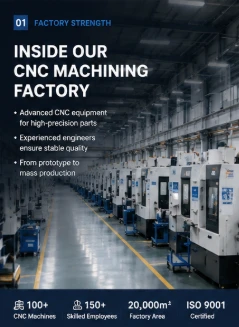
Why Choose Jingcheng for CNC Plastic Prototype Manufacturing?
Jingcheng provides professional CNC plastic machining and rapid prototyping services for customers worldwide.
Our capabilities include:
- CNC milling and turning
- 3-axis and 5-axis machining
- Plastic prototype manufacturing
- Low-volume production
- Engineering plastic machining
- Surface finishing services
We work with various plastic materials, including:
- ABS
- POM
- PC
- Nylon
- PEEK
- PTFE
With advanced CNC equipment and experienced engineers, Jingcheng helps customers transform ideas into accurate, functional prototypes.
FAQ
Q: Is CNC machining better than 3D printing for prototypes?
A: It depends on the application. CNC machining is better for functional prototypes requiring high accuracy, strong materials, and production-like performance. 3D printing is better for quick concept models and complex designs.
Q: Is CNC plastic machining more expensive than 3D printing?
A: For single simple prototypes, 3D printing may be cheaper. However, CNC machining becomes more cost-effective when prototypes require high accuracy, engineering materials, or multiple testing cycles.
Q: Can CNC machining produce medical prototypes?
A: Yes. CNC machining is widely used for medical prototypes because it can process high-performance plastics such as PEEK and produce precise functional components.
Q: Which method is better for low-volume production?
A: CNC plastic machining is usually better for low-volume production because it provides consistent quality, better materials, and production-level performance.
Conclusion
Both CNC plastic machining and 3D printing play important roles in modern prototype development.
3D printing provides speed, flexibility, and design freedom for early-stage concepts. However, when prototypes require high precision, excellent surface finish, and real engineering materials, CNC plastic machining is often the better choice.
For companies developing medical devices, robotics, industrial equipment, and consumer products, choosing the right prototyping method can significantly improve product quality and reduce development risks.
Jingcheng provides reliable precision CNC plastic machining and rapid prototyping services to help engineers move from concept design to successful production.