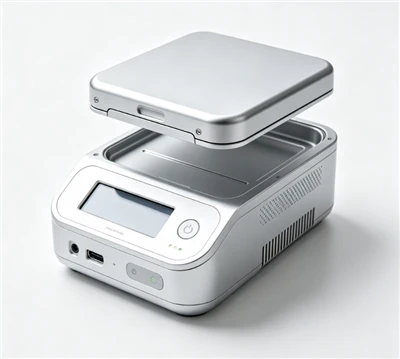
Shenzhen Jingcheng Dingyi Forming Technology Co., Ltd. is one of the leading manufacturers and suppliers of injection molded plastic enclosure in China, specialized in providing high quality customized products. If you're going to buy bulk cheap injection molded plastic enclosure, welcome to get quotation from our factory. Quality products and low price are available.
Key Benefits
- Robust protection: Resistant to impact, dust, moisture, chemicals, and UV exposure (depending on material and rating).
- Lightweight yet strong: Ideal alternative to metal housings when weight, corrosion resistance, or cost matter.
- Design flexibility: Complex shapes, integrated bosses, snap-fits, mounting features, and tight tolerances are easily achieved.
- Material options: ABS, polycarbonate (PC), polycarbonate/ABS blends, polypropylene (PP), nylon, and specialty grades for flame retardancy (UL94), outdoor use, or EMI shielding.
- IP ratings available: From basic dust protection to IP65, IP66, IP67, and higher sealed versions.
- Cost-efficient scaling: Tooling investment pays off quickly for medium-to-high production volumes; excellent part-to-part consistency.
- Aesthetic & functional finishes: Smooth surfaces, textured options, color matching, and ready-to-assemble designs.
Common Applications
- Electronics and PCB housings
- Industrial control boxes and junction boxes
- IoT devices, sensors, and smart meters
- Medical and laboratory equipment housings
- Outdoor and harsh-environment enclosures
- Consumer product casings and power supply housings
- Automotive and transportation electronics
Common Used material in Injection molded plastic enclosure

Characteristics: Density of 0.9-0.91g/cm ³, melting point of 160-170 ℃, resistant to chemical solvents (acid/alkali) and excellent electrical insulation, but obvious low-temperature brittleness (brittleness temperature -10 ℃).
Modification direction
Flame retardant PP: achieved UL94 V-0 level (1.6mm thickness) by adding nitrogen phosphorus flame retardants, suitable for power supply housing 13;
Fiberglass reinforced PP: The bending modulus has been increased to 4500MPa, and it is used for structural components injection plastic parts such as washing machine barrels.
Application Cases :Refrigerator drawers (resistant to low temperatures up to -25 ℃), small appliance bases (injection molding cycle<30 seconds)

Polyethylene (PE)
Compare LDPE & HDPE:
LDPE Type Density (g/cm ³) is 0.92g/cm3, MPa is 10-20, the Typical Applications is wire sheath/flexible seal
HDPE Type Density (g/cm ³) is 0.95g/cm3, MPa is 25-35, the typical applications is vacuum cleaner housing/load-bearing components.
The processing advantages are excellent fluidity (melt index>20g/10min), suitable for complex thin-walled parts (wall thickness 0.5mm).

ABS
Core performance:Impact resistance ≥ 20kJ/m ² (23 ℃), surface glossiness>90% (can be electroplated/sprayed), but poor weather resistance (yellowing after UV irradiation) ABS improves processing fluidity (melt index 22g/10min) and surface decorative properties
Mainly used in household appliances plastic parts, such as TV front cases (high glossy surfaces) and toy shells.

PC
The hot deformation temperature is 130-135 ℃, and the short-term temperature resistance can reach 160 ℃. Low temperature temperature -130 ℃, suitable for a wide temperature range (-60 ℃ to 120 ℃), surface can be electroplated/sprayed.
Modification and upgrading direction
Fiberglass reinforced PC: bending strength increased to 180MPa (30% fiberglass)
Flame retardant PC: Passed UL94 V-0 (1.5mm thickness) and GB/T 2408 needle flame test
Medical grade PC: Impact intensity attenuation after gamma ray sterilization<5%
Making Injection molding plastic enclosure process
Mold development stage (Lead time: 15-30 days)
1. Mold design
(a) 3D modeling and simulation
Build a 3D model of the shell based on CAD software (such as Solid Works), predict the filling state of the melt through Mold flow flow analysis, optimize the gate position (to avoid the influence of the weld line on the appearance area) and the layout of the cooling water channel (temperature difference control ≤± 1 ℃)
Selection of mold core materials
Pre hardened steel S136H (HRC 52) or quenched hardened steel H13 (HRC 48-52) shall be used, and deep cavity structural components shall be equipped with a nitrogen assisted demolding system
(b). Mold manufacturing and debugging
Precision machining
Use a five axis machining center to carve and mill the mold cavity (accuracy ± 0.01mm), and EDM to machine deep holes and irregular structures.
2.Trial mold verification
3D printing rapid prototyping (72 hour delivery) for first sample verification, adjusting the pin layout (force<80MPa), optimizing the exhaust groove depth (0.02-0.03mm)
Raw material pre treatment (key impact on yield rate)
The process includes drying and dehumidification, as well as color mixing. During drying and dehumidification, the PC material is used at 120 ℃ for 4 hours (dew point -40 ℃), and the equipment configuration is a dehumidification dryer (residual moisture ≤ 0.02%).
The parameter requirements for color matching and mixing are a color masterbatch ratio of 1% -4%, a mixing uniformity of>98%, and a high-speed mixing machine (with a speed of 800rpm).
Core injection molding process (full cycle: 20-120 seconds)
1. Melt plasticization
Screw temperature zoning control (such as ABS: feed section 180 ℃ → homogenization section 220 ℃)
Back pressure setting: 5-10MPa for general plastics, 12-18MPa for engineering plastics (to prevent overheating degradation)
2. Injection filling
A [Injection Start] -->B {Multi stage Control}
B -->| Phase 1 | C [High speed filling of cavity 80%]
B -->| Second stage | D [Low speed pressure holding and anti flying edge]
B -->| Third Stage | E [Pressure Maintenance Shrinkage]
Injection pressure: thin-walled parts (100-150MPa), thick walled parts (60-80MPa)
Time control: Filling time ≤ 1/10 of cooling time (e.g. filling with 2mm wall thickness for about 3 seconds)
3. Pressure holding cooling
The holding pressure is approximately 60% of the injection pressure, lasting until the gate solidifies
Variable mold temperature control: filling period of 80 ℃ → cooling period of 30 ℃ (reducing internal stress)
4. Demoulding and ejecting
Top needle speed grading control: Initial low speed (anti white printing) → End high speed
Gas assisted demolding (pressure 0.3-0.5MPa) is used for deep cavity components
Post processing technology
(a). Appearance treatment
Sandblasting/Scratching: Sa 2.5 surface treatment (Ra 3.2 μ m)
IMD decoration: PET film pre printed pattern (1200dpi), injection molding fusion temperature of 200-230 ℃
(b). Assembly and sealing
Ultrasonic welding: frequency 20kHz, amplitude 50 μ m (sealing up to IP67)
Laser engraving: depth 0.1mm (medical shell traceability code marking)

Quality Control System
1. Online detection items
The dimensional tolerance is measured by three coordinate inspection (Zeiss), with a standard of ± 0.05mm (critical mating surface)
Surface defects are detected by A01 visual inspection method, with scratches ≤ 0.02mm and no exposed fusion lines.
2. Reliability verification
Environmental testing: Aging at 85 ℃/85% RH for 1000 hours (Δ size<0.1%)
Mechanical strength: Drop test 1.5m, 3 times on each side (no cracking)
FAQ
Q: What materials can be used for injection molded medical housings?
A: Common options include PC, ABS, PC/ABS, PP and PEEK. The final material should be selected according to the device's mechanical, chemical, environmental and sterilization requirements.
Q: Can you manufacture custom medical device housings?
A: Yes. We manufacture custom injection molded housings according to customer drawings, 3D CAD files and technical specifications.
Q: Can the housing include mounting bosses and snap-fits?
A: Yes. Mounting bosses, ribs, snap-fits, locating features, screw posts and connector openings can be incorporated directly into the injection molded design.
Q: Can you provide prototypes before mass production?
A: Yes. Prototype or low-volume production can be arranged before moving to larger-scale injection molding production.
Q: What information is needed for a quotation?
A: Please provide the 3D CAD file or drawing, material specification, estimated quantity, surface finish requirements and application requirements. If available, also provide the expected production volume and any special quality or documentation requirements.
Q: Can you manufacture two-piece medical housings?
A: Yes. We can manufacture upper and lower housing components designed to assemble using screws, snap-fits, ultrasonic welding or other specified joining methods.
Q: Do medical housings require medical-grade plastic?
A: Not necessarily. The appropriate material depends on the housing's intended use, patient contact, cleaning/sterilization conditions and regulatory requirements. Material selection should be determined according to the specific medical device application.
Hot Tags: injection molded plastic enclosure, China injection molded plastic enclosure manufacturers