What Is Hard Anodizing?
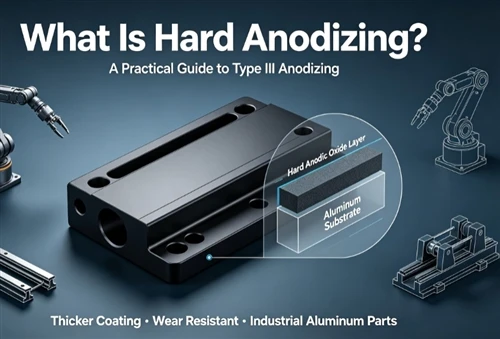
Hard anodizing is an electrochemical treatment that forms a protective oxide layer on an aluminum surface.
Compared with standard Type II anodizing, Type III hard anodizing generally produces a thicker and harder surface layer. This makes it suitable for aluminum components exposed to friction, abrasion, repeated movement, or demanding industrial environments.
Typical hard anodizing thickness is often around 25–50 μm, although the actual thickness depends on the aluminum alloy, processing conditions, part geometry, and customer requirements.
What Are the Benefits of Hard Anodizing?
1. Better Wear Resistance
Hard anodizing significantly improves the surface's resistance to wear and abrasion. It is suitable for components that experience repeated movement or mechanical contact.
2. Improved Corrosion Resistance
The anodized oxide layer helps protect aluminum from corrosion and environmental exposure.
3. Higher Surface Hardness
Hard anodized aluminum has a much harder surface than untreated aluminum, helping reduce scratches and surface damage during use.
4. Lightweight Protection
Aluminum remains lightweight after anodizing, making the process useful for applications where both durability and weight reduction are important.
Hard Anodizing vs. Standard Anodizing
Both processes are used to protect aluminum, but they serve different purposes.
| Feature | Standard Anodizing | Hard Anodizing |
|---|---|---|
| Common Type | Type II | Type III |
| Main Purpose | Appearance & corrosion resistance | Wear resistance & durability |
| Coating | Thinner | Thicker |
| Surface Hardness | Moderate | Higher |
| Color Options | More options | Usually more limited |
| Typical Applications | Housings, consumer products | Mechanical & industrial parts |
If appearance and color are the main priorities, Type II anodizing may be sufficient. If the part experiences significant wear or friction, Type III hard anodizing is usually a better option.
Which Aluminum Is Suitable for Hard Anodizing?
Many aluminum alloys can be hard anodized, but the final appearance and coating characteristics vary between materials.
Common CNC machining materials include:
6061 aluminum – excellent machinability and commonly used for CNC parts
7075 aluminum – high strength and suitable for demanding mechanical applications
6063 aluminum – good surface appearance and commonly used for decorative applications
For precision mechanical components, 6061 and 7075 aluminum are frequently selected.
If appearance is important, it is recommended to confirm the expected anodized appearance before mass production because different aluminum alloys can produce different colors and surface textures.

Common Applications of Hard Anodized CNC Parts
Hard anodizing is commonly used for aluminum components in:
- Robotics
- Automation equipment
- Industrial machinery
- Aerospace
- Automotive systems
- Electronic equipment
- Precision mechanical devices
For example, robot joint housings, motor housings, robot arm components, brackets, and mechanical fixtures may benefit from hard anodizing because these parts can experience repeated movement and mechanical contact.
When Should You Choose Hard Anodizing?
Hard anodizing is worth considering when your aluminum CNC part requires:
High wear resistance
Improved corrosion resistance
Better surface durability
Protection against scratches
A durable industrial surface
However, it may not be necessary for every component. For internal parts with low exposure to wear, an as-machined finish or standard anodizing may provide a more cost-effective solution.

One-stop CNC Factory in China
Hard anodizing is a reliable surface treatment for CNC machined aluminum parts that require better wear resistance, corrosion resistance, and surface hardness.
The right solution depends on the aluminum alloy, part geometry, dimensional tolerances, operating environment, appearance requirements, and production quantity.
At Shenzhen Jingcheng Dingyi Precision Manufacturing Co., Ltd., we provide precision CNC machining for aluminum and other engineering materials, with surface finishing options including Type III hard anodizing, standard anodizing, bead blasting, polishing, and passivation.
Have an aluminum CNC part that requires hard anodizing? Send us your 2D drawing or 3D CAD file and our team can review your requirements and recommend a suitable manufacturing solution.
[Get a Free CNC Machining Quote →]
FAQ
Q: 1. What is hard anodizing?
A: Hard anodizing, also called Type III anodizing or hardcoat anodizing, is an electrochemical surface treatment that creates a thick, hard oxide layer on aluminum parts. It improves wear resistance, corrosion resistance, and surface durability.
Q: 2. What is the typical hard anodizing thickness?
A: Hard anodizing is commonly specified around 25–50 μm, although the actual thickness depends on the aluminum alloy, part geometry, processing conditions, and project requirements.
Q: 3. Does hard anodizing affect CNC part dimensions?
A: Yes. The anodized layer can affect the final dimensions of holes, threads, bearing bores, and mating surfaces. Critical dimensions should be considered during CNC machining, and some areas may require masking.
Q: 4. What aluminum alloys can be hard anodized?
A: Common CNC aluminum alloys such as 6061, 6063, and 7075 can be hard anodized. However, different alloys may produce different surface colors and finishes.
Q: 5. What color is hard anodized aluminum?
A: Hard anodized aluminum is commonly available in dark gray, gray, or black. Compared with Type II anodizing, Type III hard anodizing generally has fewer color options.
Q: 6. Is hard anodizing better than standard anodizing?
A: Not necessarily. They are designed for different purposes. Standard anodizing is often preferred for appearance and general corrosion protection, while hard anodizing is better suited to parts requiring higher wear resistance and durability.
Q: 7. Is hard anodizing suitable for robot parts?
A: Yes. Hard anodizing can be a good choice for CNC aluminum robot components such as robot joint housings, motor housings, arm links, and mechanical brackets, especially when the parts experience repeated movement or friction.
Q: 8. How do I specify hard anodizing on a CNC drawing?
A: Your drawing should ideally specify the anodizing type, coating thickness, color, masking areas, and critical dimensional requirements. For example: Type III Hard Anodizing, Black, 25 μm, mask bearing surfaces.
Q: 9. Does hard anodizing increase CNC machining costs?
A: Yes. Hard anodizing adds an additional finishing process, so it increases the overall manufacturing cost. The final price depends on part size, quantity, material, coating thickness, masking requirements, and surface preparation.
Q: 10. Can you provide CNC machined parts with hard anodizing?
A: Yes. We can provide CNC machined aluminum parts with Type III hard anodizing, as well as other finishes such as standard anodizing, bead blasting, polishing, and passivation. You can send your 2D drawing or 3D CAD file for a project evaluation and quotation.