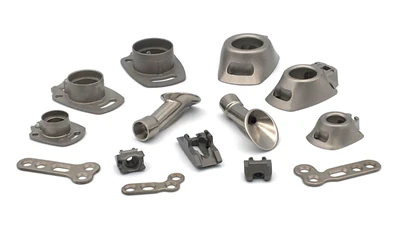
Why Is 3-Axis CNC Machining Challenging for Complex Robot Joints?
During prototype development, engineers may encounter several problems when machining complex joint components using 3-axis CNC machines and custom fixtures.
Accumulated Alignment Errors
When a component requires multiple setups and repositioning operations, small alignment errors can accumulate. This can affect the coaxiality of bearing seats at opposite ends of a robotic joint, potentially compromising assembly accuracy.
Inconsistent Surface Finish on Complex Contours
Machining curved surfaces with conventional 3-axis methods may require multiple tool orientations and finishing passes. In certain cutting conditions, especially when using ball-end mills, the effective cutting speed near the tool tip can become very low, resulting in poor surface finish or visible tool marks.
Longer Lead Times Due to Multiple Setups
Every additional setup may require repositioning, fixture adjustments, and new inspection steps. For robotic development teams working toward prototype assembly deadlines, these operations can slow down design validation and product iteration.

How 5-Axis Simultaneous Machining Improves Robot Joint Manufacturing
By controlling three linear axes and two rotary axes simultaneously, a 5-axis CNC machine can machine complex features from multiple orientations while reducing the need for repeated setups.
For robotic joint components, this capability offers several practical advantages.
A. Fewer Setups for Better Positional Accuracy
5-axis machining allows multiple faces and angled features to be machined in a single setup, depending on the part geometry and machine configuration.
For components with reducer mounting surfaces, motor interfaces, angled holes, and bearing seats, reducing repositioning can help maintain the positional relationships between critical features.
Manufacturing benefit: Fewer setups mean fewer opportunities for datum shifts and fixture-related errors. This can improve the consistency of alignment-critical robotic components.

B. Better Tool Orientation for Improved Surface Finish
During simultaneous 5-axis machining, the tool and workpiece can change orientation to maintain a more suitable cutting angle along complex contours.
This can improve tool engagement, reduce certain types of tool marks, and help achieve a more consistent surface finish.
For robotic joint housings and other moving components, better surface quality can support accurate assembly and reduce the need for secondary finishing operations.
A surface roughness target of Ra 0.8 μm may be achievable for suitable geometries and machining conditions, but the actual result depends on the material, toolpath, cutting parameters, and inspection method.

C. Shorter Tools for Greater Machining Stability
Deep cavities and angled features can require long cutting tools when machined using conventional approaches. Long tools are more susceptible to deflection and vibration.
5-axis machining can provide better tool access by adjusting the tool orientation, allowing shorter tools to be used in suitable applications.
For robotic joints machined from 7075 aluminum or titanium alloys, improved tool rigidity can help control vibration, dimensional variation, and surface quality.
3-Axis vs. 5-Axis CNC Machining for Robot Joint Components
The following table illustrates typical differences that may arise when machining complex robotic components. Actual results depend on part geometry, machine capability, process planning, and inspection requirements.
| Performance Factor | 3-Axis Machining with Multiple Setups | 5-Axis CNC Machining |
|---|---|---|
| Number of setups | May require 5 or more for complex parts | May be reduced to 1–2 |
| Alignment accuracy | Errors may accumulate between setups | Fewer setups help preserve feature relationships |
| Fixture development | Additional fixtures may be required | Fixture requirements may be reduced |
| Complex curved surfaces | May require multiple operations and finishing passes | Flexible tool orientation supports complex contours |
| Deep cavities and angled holes | Tool access can be challenging | Improved tool access for suitable geometries |
| Prototype development | Additional setup and inspection time | Potentially shorter process lead times |
For example, a suitable part may achieve coaxiality or positional tolerances in the 0.01–0.015 mm range under a well-controlled manufacturing process. However, these values should not be treated as guaranteed results for every 5-axis machined component.
Similarly, achieving Ra 0.8 μm requires appropriate tooling, cutting conditions, and verification. A 5-axis machine alone does not guarantee a particular tolerance or surface finish.
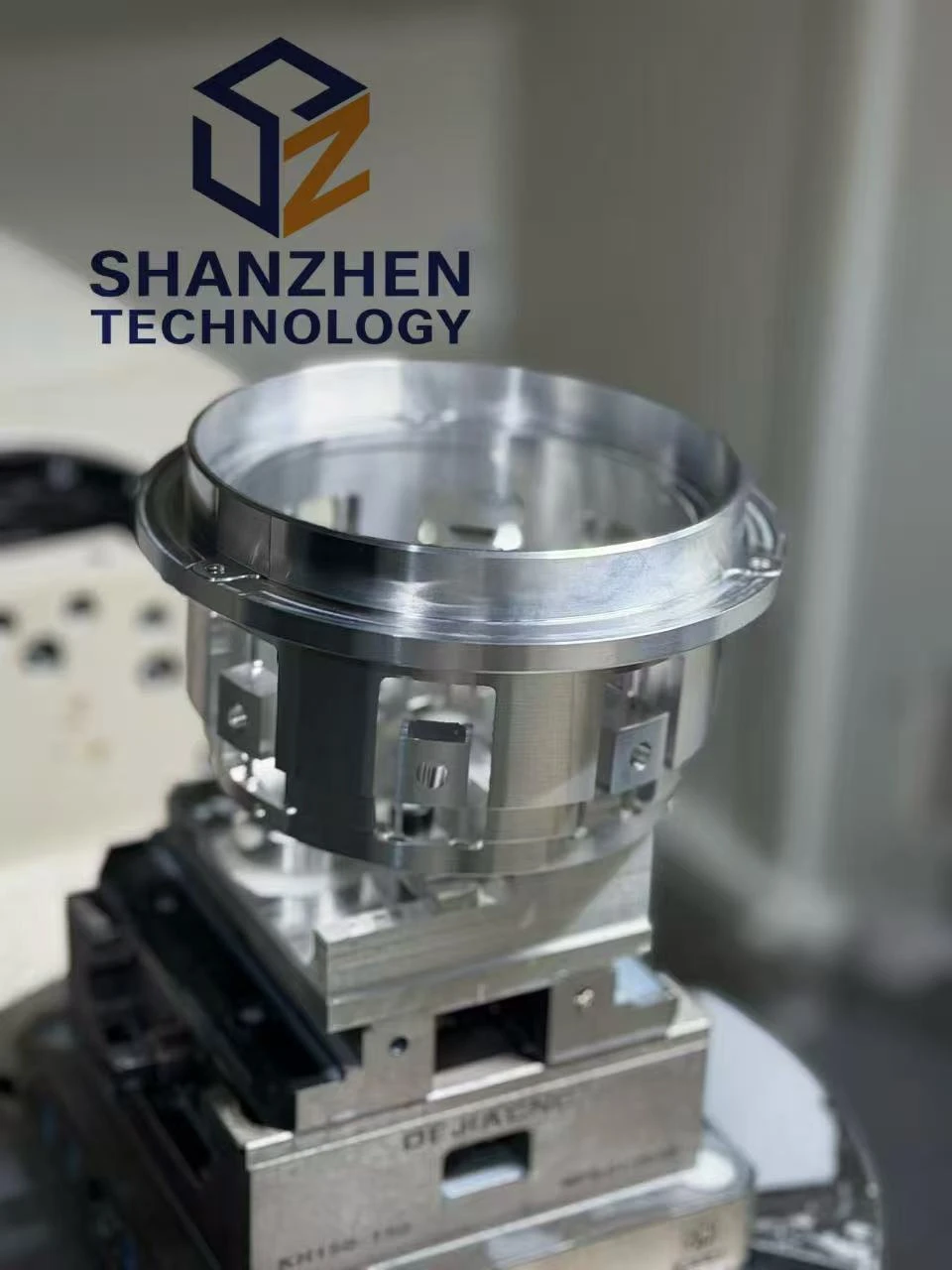
Quality Control and Lead Time in Precision 5-Axis Machining
Complex robotic joints require more than advanced equipment. Process planning, machining simulation, dimensional inspection, and material stability all play important roles in achieving repeatable results.
DFM Review and Toolpath Simulation
Before machining begins, engineers can review the part geometry and identify potential manufacturing challenges, including tool interference, inaccessible features, thin walls, and difficult clamping positions.
CAM programming and machining simulation help evaluate toolpaths and potential collisions before production. This is particularly important for components with multiple angled features and complex internal geometries.
Dimensional Stability and Stress Management
Large amounts of material removal can introduce or release residual stresses, potentially causing dimensional changes during or after machining.
Depending on the material, part geometry, and tolerance requirements, the manufacturing process may incorporate stress-relief treatment, staged machining, temperature stabilization, and additional dimensional inspections.
A production cycle of 5–10 days may be suitable for certain parts, but the actual lead time depends on material availability, geometry, machining complexity, inspection requirements, and order quantity.
Support for Urgent Prototype Projects
Robot development schedules often change as engineers validate new designs and prepare for assembly testing.
Optimized toolpaths, efficient setup planning, and coordinated inspection can help shorten manufacturing lead times. Expedited production may also be possible depending on machine availability and part complexity.
For prototype and low-volume projects, early communication about critical dimensions, assembly interfaces, and delivery deadlines helps establish a realistic manufacturing plan.
Choosing a CNC Machining Partner for Complex Robot Joints
When evaluating a supplier for custom robotic joint components, engineers should look beyond the number of axes on a machine.
Important factors include:
Relevant machining capability: Experience with complex housings, bearing seats, angled holes, and multi-face components.
Material experience: Familiarity with aluminum alloys, stainless steel, titanium, and other engineering materials specified in the drawings.
Dimensional inspection: Appropriate measurement methods for critical diameters, positional tolerances, coaxiality, and flatness.
Manufacturing communication: Early feedback on manufacturability, clamping strategies, tolerances, and potential cost-saving changes.
Prototype flexibility: The ability to support design iterations and low-volume production without unnecessary tooling complexity.
A capable manufacturing partner should help engineers identify which features genuinely require 5-axis machining and which can be produced more economically using 3-axis machining or a combination of processes.
Conclusion
5-axis simultaneous CNC machining can play an important role in manufacturing complex robotic joint components. By reducing setups, improving tool access, and enabling more flexible tool orientation, it can help manufacturers manage intricate geometries and maintain critical dimensional relationships.
However, precision depends on the entire manufacturing process-not just the machine. Toolpath planning, material behavior, fixture design, machining parameters, and dimensional inspection all contribute to the final result.
For robotics developers working on collaborative robots, humanoid robots, and other motion-control systems, selecting the right machining strategy early can help balance part complexity, manufacturing cost, dimensional accuracy, and prototype lead time.
Need custom CNC-machined robotic joint components? Share your drawings, material specifications, critical tolerances, and target quantity with JCTOP to discuss manufacturability and a suitable machining approach.