Why Are Carbon Fiber Parts Used in Drones?
Lightweight but Strong
Weight directly affects drone performance. A lighter structure can reduce energy consumption and help increase flight time or payload capacity.
Carbon fiber offers an excellent strength-to-weight ratio, making it suitable for drone components that need to remain lightweight without sacrificing structural performance.

High Stiffness and Better Stability
During flight, drone structures are constantly exposed to vibration from motors and propellers.
Carbon fiber provides high stiffness, helping reduce unnecessary structural movement. This is particularly important for drones carrying cameras, sensors, inspection equipment, or other precision payloads.
Good Corrosion Resistance
Drones are often used outdoors in challenging environments.
Unlike ordinary steel components, carbon fiber does not rust, making it a practical option for many UAV and industrial drone applications.
Common Carbon Fiber Drone Parts
Carbon fiber can be used for a wide range of UAV components, including:
- Drone frames
- Drone arms
- Motor mounting plates
- Camera brackets
- Sensor mounting parts
- Reinforcement plates
- Lightweight structural panels
However, many of these parts require precision holes, complex profiles, angled surfaces, or custom mounting interfaces.
This is where CNC machining becomes important.
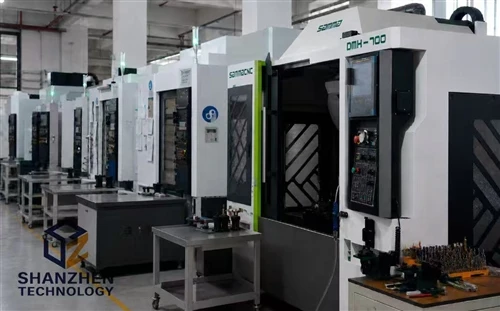
Why Use 5-Axis CNC Machining?
Compared with traditional 3-axis machining, 5-axis CNC machining allows cutting tools to approach a part from multiple angles.
This provides several advantages for complex carbon fiber drone components.
Fewer setups: Complex features can often be machined with fewer repositioning operations.
Higher accuracy: Precision mounting holes and multi-angle features can be produced more consistently.
More design freedom: 5-axis machining can access complex surfaces that are difficult to machine using standard equipment.
Improved efficiency: Reducing setups and manual handling can help shorten production time, especially for prototypes and low-volume custom parts.
Carbon Fiber Machining Requires Experience
Carbon fiber is highly abrasive and requires appropriate machining processes.
Incorrect tools or cutting parameters can cause problems such as edge fraying, delamination, and excessive tool wear.
For this reason, the machining process should consider factors such as material structure, cutting tools, machining parameters, and dust extraction.

Custom CNC Machining for Drone Components
At Shenzhen Jingcheng Dingyi Forming Technology Co., Ltd., we provide custom CNC machining services for precision parts and prototypes.
With 3-axis and 5-axis CNC machining capabilities, we can support the production of custom components based on customer drawings and 3D models.
From carbon fiber structural components to precision aluminum and metal drone parts, we help manufacturers turn engineering designs into finished components.
Have a custom drone or UAV project? Send us your drawings or 3D files to discuss your manufacturing requirements.