1. Where metal 3D printing wins: skeletons, joints, fingers and shells
Frames and brackets: light enough, and built to survive repeated motion
Torsos, shoulders, arms and legs are full of load-bearing structures. They connect motors, reducers and bearings while absorbing the repeated loads of walking, turning and lifting. Too heavy, and every joint pays the price. Too complex, and machining and assembly get harder. This is where metal 3D printing earns its keep.
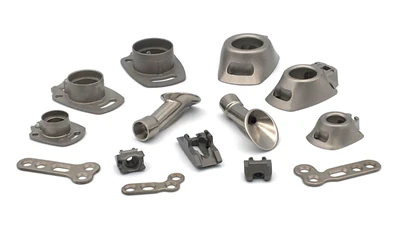
At the 2026 World Robot Expo, Bright Laser Technologies (BLT) showcased shoulder brackets, torso structures and finger motor mounts made for humanoid robots. In its disclosed cases, the shoulder bracket lost 46% of its weight through part consolidation and structural optimization; the torso structure lost 49% through optimized load paths and multi-scale lattice structures.
In the collaboration BLT announced with UBTech in 2025, an upper-arm housing was produced in BLT-AlAM400 aluminum on a BLT-A320 machine, with a reported machine time of 16.5 hours. The partnership also developed the Photon Finger, described as the world's smallest six-axis force sensor.
Beifeng disclosed a lightweight robot bracket combining topology optimization, hollow design and its own GA520 high-strength aluminum alloy - 500 MPa tensile strength, more than 20% weight reduction and a delivery cycle of about 48 hours. Beifeng reports a fleet of more than 100 metal 3D printing machines, with parts installed on products from leading domestic robot makers.
Joints and actuators: print the housing, machine the drivetrain
A rotary joint typically contains a motor, reducer, bearings, an encoder, a housing and output structure. A linear joint may use a lead screw to convert rotation into linear motion.
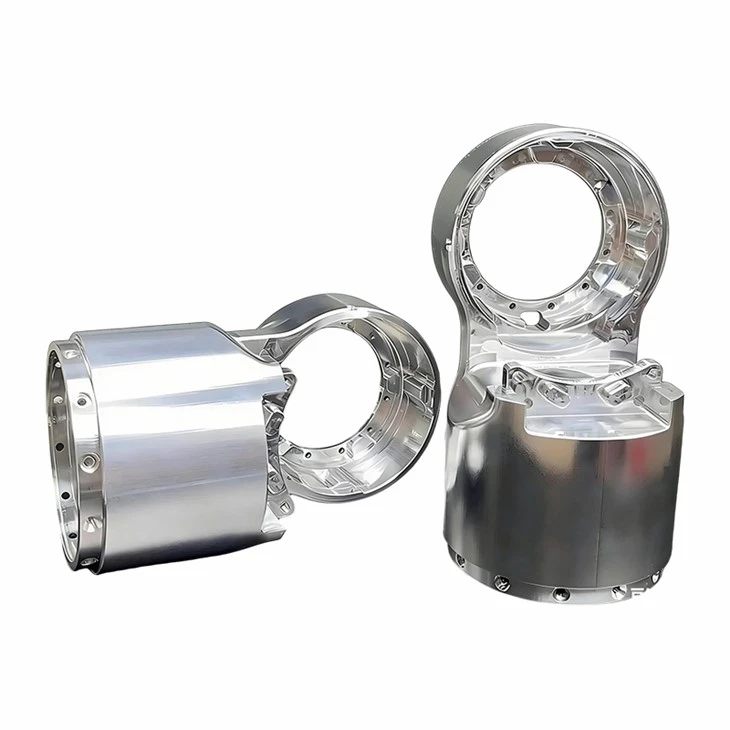
Metal 3D printing is worth exploring for motor mounts, joint housings, reducer housings and structures with complex internal routing. Features that are difficult to machine in one piece can be consolidated into a single printed part; brackets that need weight reduction or multiple mounting features avoid excess material removal and assembly steps.
But the parts with the most demanding internal requirements - motors, reducers, lead screws - still go through five-axis CNC, followed by precision cutting and grinding.

Dexterous hands: complex finger structures are the interesting case
A dexterous hand is far more complex than a standard gripper. Fingers bend repeatedly and contain transmission parts, shaft holes, limit features, cable routing - and, in some designs, tendon cables or tactile sensors. Parts are small and dense, and assembly clearances directly affect performance.
In 2026, Farsoon showed titanium dexterous-hand components made with metal 3D printing: finger-joint housings, mounting structures and internal features consolidated into single printed parts, using a 20 µm powder layer, with a reported dimensional accuracy of ±0.05 mm and vertical surface roughness within Ra 3.2 µm.
The value is one-piece consolidation - routing channels, complex surfaces and internal cavities designed directly into the part and produced in a single step.

Shells and soft parts: more than wrapping the robot
Robot shells need to be judged by function. Head, chest and arm covers mainly protect, enclose and present; some housings also locate, support and dissipate heat. Flexible skins and foot buffers need elasticity, impact resistance and repeated deformation.
For covers, 3D printing makes it easy to change curvature, openings, snaps and internal mounting structures - genuinely useful when a robot has many variants, frequent revisions or small batches.
Yingpu 3D reported a robot development project using a P360 system with glass-fiber reinforced nylon: 52 limb structural parts printed in 32.5 hours, consuming 46.78 kg of powder, with a 20% new / 80% recycled powder blend.
For soft components, Farsoon demonstrated PEBA flexible material for cushioning and impact protection. After supercritical physical foaming, printed density falls to as low as 0.03 g/cm³ - about 70% lighter than conventional TPU - and the material survived 200,000 bend cycles without degradation. Boli, meanwhile, applies photopolymer elastomers to bionic skin and foot buffers, using flexible materials for cushioning, contact and controlled deformation.

2. Where MIM fits: the tiny, complex metal parts inside dexterous hands
Micro gears, connectors, limit parts and some transmission structures must be small - and also strong, wear-resistant and dimensionally consistent. At volume, machining them all by CNC inflates cost and lead time. MIM mixes metal powder with a binder, injection-molds the mixture, then debinds and sinters it - a good fit for complex, small metal parts with stable demand.
NBTM's MIM technology platform generated RMB 1.307 billion in revenue in the first half of 2026, up 8.25% year on year. The company is exploring MIM for precision dexterous-hand components and is pursuing powder metallurgy compaction routes for robot reducer parts.
Jingyan Technology - a MIM specialist that also makes transmission components - reported roughly RMB 337 million in embodied-intelligence equipment revenue in H1 2026, up 77.48%.
The read: MIM suits components that are mature, structurally complex and have genuine volume. If your robot is still changing weekly - many part numbers, low volume per part - CNC or 3D printing is the better call.
3. Why CNC owns the present
Today, CNC remains the principal way joints, actuators and precision connection parts are made.
Changying Precision delivered roughly 860,000 humanoid-robot precision components in H1 2026, covering dexterous-hand transmission parts, rotary actuator core transmission parts, lead-screw core transmission parts, torso transmission parts and skeletal structural parts. Its toolbox includes CNC, 3D printing, die casting, injection molding, gear hobbing and hot pressing.
Lingyi iTech's case is even more direct. At the 2026 Beijing Yizhuang humanoid robot half-marathon, the 159 core metal structural parts of the Honor "Lightning" robot were supplied by Lingyi's Hengli plant, covering key motion units in the hips, legs, feet and torso - already in batch delivery.
The pattern is clear: an OEM does not need one "star process." It needs hundreds of structural parts of different sizes, materials and tolerance requirements, delivered consistently. CNC already has the equipment, the process maturity and the customer-validation track record - which is exactly why it is penetrating so quickly.
4. Nobody replaces anybody: the processes coexist
3D printing's opportunity is complexity. When a part demands several things at once - light, strong, one-piece, fast to iterate - additive manufacturing has the edge. Over time it may gain ground on certain joint and dexterous-hand precision components, but it will not broadly replace MIM, precision machining or conventional processes.
MIM is waiting for volume. When designs mature, a single part number carries enough demand, and materials and tolerances suit injection molding, MIM gets its wave. Until then, its cost advantage stays theoretical.
CNC's opportunity is now. The industry is still in design-revision, prototype-validation and small-batch delivery mode. Customers need a process that responds quickly, holds accuracy and is already proven.
Stamp, injection and forging routes need standardization and scale. Once a design freezes and single-model orders keep growing, their advantage shows up in repeatable mass production.
The industry will not simplify into one process replacing another. The processes coexist, and each carries the parts it is best at. The real differentiator is whether a supplier can cross the line from "we can make it" to "we deliver it reliably, at cost, at scale."
5. What this means when you choose a manufacturing partner
|
Part type |
What wins today |
Why |
|
Joint housings, actuator brackets |
5-axis CNC |
Bearing bores to ±0.003–0.005 mm, thin-wall stability, fatigue life |
|
Drivetrain parts (lead screws, reducers) |
CNC + grinding |
Internal precision cannot be printed |
|
Complex, lightweight, consolidated structures |
Metal 3D printing |
One-piece, topology-optimized, hard to machine |
|
Micro gears, connectors, limit parts (stable volume) |
MIM |
Cost at volume; needs design freeze |
|
Shells, covers (early iteration) |
3D printing (SLA/SLS) |
Fast geometry changes, low volume |
Three practical rules for your project:
Design for the process, not the hype. Metal AM earns its keep on consolidated, lightweight, complex geometries. Do not print a part that is cheaper and faster to machine.
CNC carries the tolerance-critical work. Joints, actuator housings, transmission and lead-screw components, structural brackets - anything with mating surfaces and fatigue life is machining work.
Prototype fast, then transfer. Validate the design early, then move to the process that wins at volume. And get a manufacturability review before you commit - that is where cost and lead time are actually decided.
That is the work we do at JCTOP every day:
Five-axis CNC machining for precision joints, actuator housings, transmission and lead-screw components and structural brackets - from a single prototype to 10,000+ pieces per month, with critical bores held to ±0.003–0.005 mm and CMM-verified on every batch.
In-house 3D printing (SLA resin, SLS nylon) to validate shells, covers and structural concepts before you commit to tooling or long programs.
Engineering-led DFM - our engineers review your STEP file for thin walls, deep bores, undercuts and micro-features, and come back within 24 hours with cost and design recommendations, at no charge.
Materials we machine - 6061-T6 and 7075-T6 aluminum, Ti-6Al-4V titanium, 17-4 PH stainless, 42CrMo4 steel, PEEK and Delrin.
FAQ
Q: Which process should I choose for my robot's joint housings?
A: If the housing is tolerance-critical and carries a drivetrain, CNC machining is the safe, proven answer. If it is a complex, integrated structure that would take many machined or assembled parts, metal 3D printing is worth evaluating. Many projects end up with a mix - printed housings and machined internal drivetrain parts.
Q: Can JCTOP machine parts that were originally designed for 3D printing?
A: Yes. When volumes rise, many parts designed for additive manufacturing can be adapted for CNC machining to cut unit cost. We review the design and suggest practical changes before quoting.
Q: What tolerance can you hold on precision robot components?
A: On critical bearing bores and pivot holes we routinely hold ±0.003–0.005 mm on 5-axis centers. All critical dimensions are verified by CMM and reported with GD&T.
Q: What is the MOQ for robot parts?
A: There is no minimum. We machine single prototype parts for design validation and scale to 10,000+ pieces per month. Every order receives the same inspection standard regardless of quantity.
Q: Do you do metal 3D printing?
A: We provide SLA resin and SLS nylon printing in-house for prototyping, and arrange metal 3D printing through partner facilities when a part is genuinely better printed. Our engineers tell you honestly which process fits - we quote CNC and printing side by side.
Q: How do I send you a design for review?
A: Send STEP or IGES files, plus a 2D drawing with GD&T if available. We sign NDAs for early-stage projects and will not share your design or your volumes. Data points in this article are as publicly disclosed by the companies cited (2025–2026). Verify current specifications before making sourcing decisions.
Not sure which process is right for your robot parts?
Send us your STEP file and we will recommend CNC, 3D printing or a hybrid workflow - with a DFM-reviewed quote within 24 hours. Contact Bella at yaqingliang277@gmail.com or WhatsApp 8614775540498.