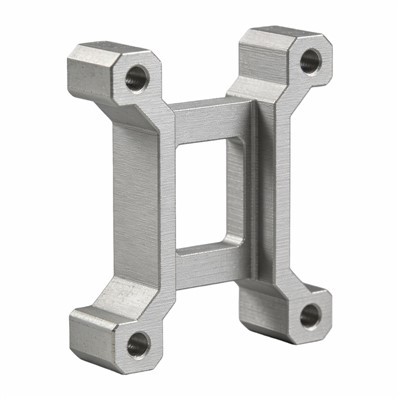
As a supplier of SLM 3D printed stainless steel models, I've witnessed firsthand the challenges that come with managing internal stresses in these parts. Selective Laser Melting (SLM) is a powerful technology that allows for the creation of complex and high - strength stainless steel components. However, the rapid heating and cooling cycles during the printing process often lead to the development of internal stresses, which can cause warping, cracking, and reduced mechanical properties. In this blog, I'll share some effective strategies to reduce these internal stresses in SLM 3D printed stainless steel models.
Understanding the Source of Internal Stresses
Before we can address the issue of internal stresses, it's crucial to understand where they come from. During the SLM process, a high - energy laser beam melts a thin layer of stainless steel powder. As the laser moves across the powder bed, the molten metal rapidly solidifies. The difference in temperature between the molten and solidified regions creates thermal gradients, which in turn generate internal stresses.
These stresses can be classified into two main types: residual stresses and thermal stresses. Residual stresses are locked into the material after the printing process is complete, while thermal stresses occur during the heating and cooling cycles. Both types can have a significant impact on the quality and performance of the printed part.
Pre - Printing Strategies
Material Selection
The choice of stainless steel powder can have a profound effect on the internal stress levels in the printed part. Different grades of stainless steel have different thermal properties, such as thermal expansion coefficients. Selecting a powder with a lower thermal expansion coefficient can help reduce the thermal stresses generated during the printing process.
For example, austenitic stainless steels like 316L are often used in SLM due to their good corrosion resistance and relatively low thermal expansion. This makes them less prone to warping and cracking compared to other grades.
Design Optimization
The design of the part plays a crucial role in managing internal stresses. Complex geometries with sharp corners and thin walls are more likely to develop high stress concentrations. By optimizing the design, we can reduce these stress concentrations and improve the overall quality of the printed part.
One approach is to use rounded corners instead of sharp ones. Rounded corners distribute the stress more evenly, reducing the likelihood of cracking. Additionally, adding support structures can help to anchor the part during the printing process and prevent warping. However, it's important to design these support structures in a way that minimizes their impact on the final part.
Pre - Heating the Build Plate
Pre - heating the build plate is an effective way to reduce the thermal gradients between the printed part and the build plate. By pre - heating the build plate to a suitable temperature, we can slow down the cooling rate of the printed part, reducing the thermal stresses.
Most SLM machines allow for the build plate to be pre - heated to a temperature of around 100 - 200°C. This pre - heating step can significantly improve the adhesion of the part to the build plate and reduce the risk of warping.
In - Printing Strategies
Laser Parameter Optimization
The laser parameters, such as laser power, scan speed, and hatch spacing, have a direct impact on the internal stress levels in the printed part. By optimizing these parameters, we can control the heat input and the cooling rate, thereby reducing the thermal stresses.
For example, increasing the laser power can increase the melting depth and improve the density of the printed part. However, too high a laser power can also lead to excessive heat input and increased thermal stresses. On the other hand, increasing the scan speed can reduce the heat input, but it may also result in incomplete melting. Therefore, finding the right balance of laser parameters is crucial.
Scan Strategy
The scan strategy used during the printing process can also affect the internal stress distribution. Different scan strategies, such as raster scanning, island scanning, and contour scanning, can be used to control the heat distribution and reduce the thermal gradients.
For instance, island scanning involves dividing the build area into smaller islands and scanning each island separately. This can help to reduce the heat accumulation in a single area and minimize the thermal stresses.
Post - Printing Strategies
Heat Treatment
Heat treatment is one of the most effective ways to relieve internal stresses in SLM 3D printed stainless steel models. By heating the printed part to a specific temperature and holding it for a certain period of time, we can allow the material to relax and reduce the residual stresses.
There are different types of heat treatments, such as annealing, stress relieving, and solution treatment. Annealing involves heating the part to a high temperature and then slowly cooling it. This process can improve the ductility and reduce the hardness of the material. Stress relieving, on the other hand, is a lower - temperature heat treatment that is mainly used to reduce the residual stresses without significantly changing the material properties.
Machining and Finishing
After heat treatment, machining and finishing operations can be carried out to further improve the surface quality and dimensional accuracy of the printed part. Machining can also help to remove any surface defects and reduce the stress concentrations.
However, it's important to note that machining can also introduce new stresses into the part. Therefore, it's necessary to use appropriate machining parameters and techniques to minimize the impact on the internal stress levels.
Conclusion
Reducing internal stresses in SLM 3D printed stainless steel models is a complex but achievable task. By implementing a combination of pre - printing, in - printing, and post - printing strategies, we can effectively manage the internal stress levels and improve the quality and performance of the printed parts.
If you're interested in our SLA 3D Printing for Medical Parts, 3D Printing Model Parts or Nylon SLS 3D Printing Parts, or if you have any questions about reducing internal stresses in SLM 3D printed stainless steel models, please feel free to contact us for a procurement discussion. We're here to provide you with high - quality 3D printing solutions and support.
References
- Gu, D., Shen, Y., & Ding, Y. (2012). Selective laser melting of biocompatible metals for rapid manufacturing of medical parts. International Materials Reviews, 57(3), 133 - 164.
- Kruth, J. P., Leu, M. C., & Nakagawa, T. (2007). Progress in additive manufacturing and rapid prototyping. CIRP Annals - Manufacturing Technology, 56(2), 525 - 546.
- Yadroitsev, I., Bertrand, P., & Smurov, I. (2010). Influence of laser scanning strategy on residual stress in selective laser melting. Journal of Materials Processing Technology, 210(12), 1695 - 1702.